



For U.S. Residents Only
Indication
Renvela® (sevelamer carbonate) is used to control phosphorus levels in adults and children 6 years of age and older with chronic kidney disease (CKD) on dialysis.
Important Safety Information
Do not use Renvela if you have a history of bowel obstruction or if you are allergic to sevelamer carbonate, sevelamer hydrochloride, or to any of the ingredients in Renvela.
Click here for additional Important Safety Information.
Please see Full Prescribing Information for Renvela (PDF).
Please see Full Prescribing Information for Sevelamer Carbonate (PDF).
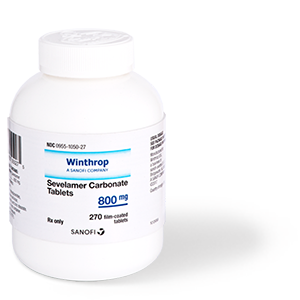
Sevelamer Carbonate
Authorized Generic
The term “authorized generic” drug is used to
describe an approved brand name drug that is
marketed without the brand name on its label. Other than the fact that
it does not have the
brand name on its
label, it is the
exact same drug
product as the
branded product.

Sevelamer Carbonate Authorized Generic
The term “authorized generic” drug is used to describe an approved brand name drug that is marketed without the brand name on its label. Other than the fact that it does not have the brand name on its label, it is the exact same drug product as the branded product.
Renvela®
Indication
Renvela® (sevelamer carbonate) is used to control phosphorus levels in adults and children 6 years of age and older with chronic kidney disease (CKD) on dialysis.
Important Safety Information
- Do not use Renvela if you have a history of bowel obstruction or if you are allergic to sevelamer carbonate, sevelamer hydrochloride, or to any of the ingredients in Renvela.
- Talk to your doctor if you have had difficulty swallowing or swallowing disorders; or if you have had digestive tract surgery or other digestive disorders, including severe constipation.
- The most common side effects with sevelamer include vomiting, nausea, diarrhea, indigestion, abdominal pain, flatulence, and constipation.
- Cases of hypersensitivity, itching, rash, stomach pain, bleeding gastrointestinal ulcers, colitis, ulceration, necrosis, fecal impaction and less commonly, slow bowel activity, bowel obstruction, and bowel perforation have been reported.
- Cases of difficulty swallowing the Renvela tablet have been reported. Talk to your doctor if you have difficulty swallowing medicines in tablet form. Renvela powder for oral suspension may be considered by your doctor if you have a history of difficulty swallowing.
- Your doctor should monitor bicarbonate and chloride blood levels.
- Reduced vitamins D, E, and K (clotting factors) and folic acid blood levels may be followed by your doctor.
- Talk to your doctor when taking sevelamer with other medications.
- Promptly contact your doctor if you experience severe abdominal pain, new or worsening constipation, or other severe intestinal symptoms while on sevelamer.
- Take sevelamer with meals and adhere to your prescribed diet
Sevelamer Carbonate
Indication
Sevelamer carbonate is used to control phosphorus levels in adults and children 6 years of age and older with chronic kidney disease (CKD) on dialysis.
Important Safety Information
- Do not use sevelamer carbonate if you have a history of bowel obstruction or if you are allergic to sevelamer carbonate, sevelamer hydrochloride or to any of the ingredients.
- Talk to your doctor if you have had difficulty swallowing or swallowing disorders; or if you have had digestive tract surgery or other digestive disorders, including severe constipation.
- The most common side effects with sevelamer include vomiting, nausea, diarrhea, indigestion, abdominal pain, flatulence, and constipation.
- Cases of itching, rash, fecal impaction and, less commonly, slow bowel activity, bowel obstruction, bleeding gastrointestinal ulcers, colitis, ulceration, necrosis and bowel perforation have been reported.
- Uncommon cases of difficulty swallowing the sevelamer carbonate tablet have been reported. Talk to your doctor if you have difficulty swallowing medicines in tablet form. Sevelamer carbonate for oral suspension may be considered by your doctor if you have a history of difficulty swallowing.
- Your doctor should monitor your bicarbonate and chloride blood levels.
- Reduced vitamins D, E, and K (clotting factors) and folic acid blood levels may be followed by your doctor.
- Talk to your doctor when taking sevelamer carbonate with other medications.
- Promptly contact your doctor if you experience severe abdominal pain, new or worsening constipation, or other severe intestinal symptoms while on sevelamer carbonate.
- Take sevelamer carbonate with meals and adhere to your prescribed diet.
Please see Full Prescribing Information for Renvela (PDF).
Please see Full Prescribing Information for Sevelamer Carbonate (PDF).
Click here to learn more about Sanofi's commitment to fighting counterfeit drugs.
 Team
Team/dcs1cl3mtt5rgwgc8fmf5ezri_5x4i/njs.gif?dcsuri=/nojavascript&WT.js=No&WT.tv=9.4.0&dcssip=www.renvela.com)